Flowers are difficult in exactly the wrong ways
Two species can share almost the same petals, while two photographs of the same species can look unrelated. Lighting shifts colour, backgrounds compete with the subject, and growth stage changes shape. That combination makes the Oxford 102 dataset a useful test of whether a model has learned visual structure or merely remembered convenient cues.
I approached the work as a full modelling pipeline: understand the data, create useful variation, design the network, tune training, use university compute responsibly, and inspect failure rather than reporting one flattering number.
Training setup
The training set is limited, so augmentation does real work. Random rotation, flips, colour jitter, affine transforms, and crops teach the network that pose or lighting may change while the species does not. Normalisation then keeps the numerical input stable across batches.
A deliberately understandable model
Images are resized to 224 × 224 pixels and passed through stacked convolution blocks with batch normalisation, ReLU activation, max pooling, and dropout. Fully connected layers then turn the learned feature maps into probabilities across 102 classes.
The architecture borrows the broad rhythm of VGG-style feature extraction but stays small enough to inspect. Beginning with a custom network made the trade-offs visible instead of hiding them behind a pretrained model on the first pass.
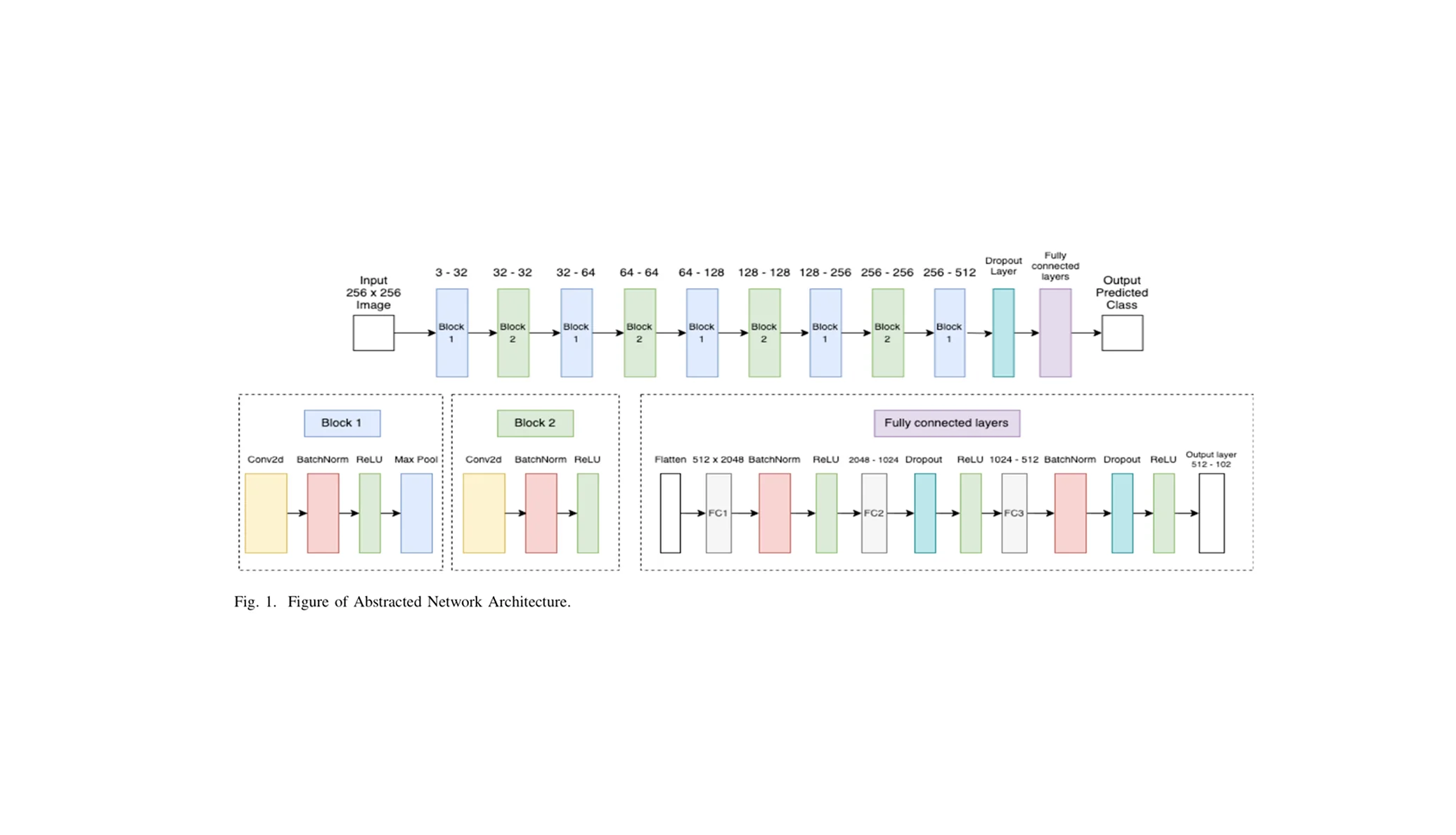 The custom convolutional architecture reduces an image into probabilities across 102 species.
Compute and optimisation
Training ran on an NVIDIA H100 GPU through the University of York’s Viking cluster. Cross-entropy loss, Adam, and weight decay formed the baseline. I compared learning rates, batch sizes, and training lengths against validation performance rather than choosing the run with the most impressive training curve.
Reading the 75.12%
The final model reached 75.12% test accuracy. It was strongest on visually distinctive flowers and weakest where species shared petal shape or colour. That pattern matters more than the number alone: it suggests the model learned useful structure, while still missing the fine-grained cues needed for close relatives. Transfer learning and attention-style mechanisms are the clearest next experiments.
First page
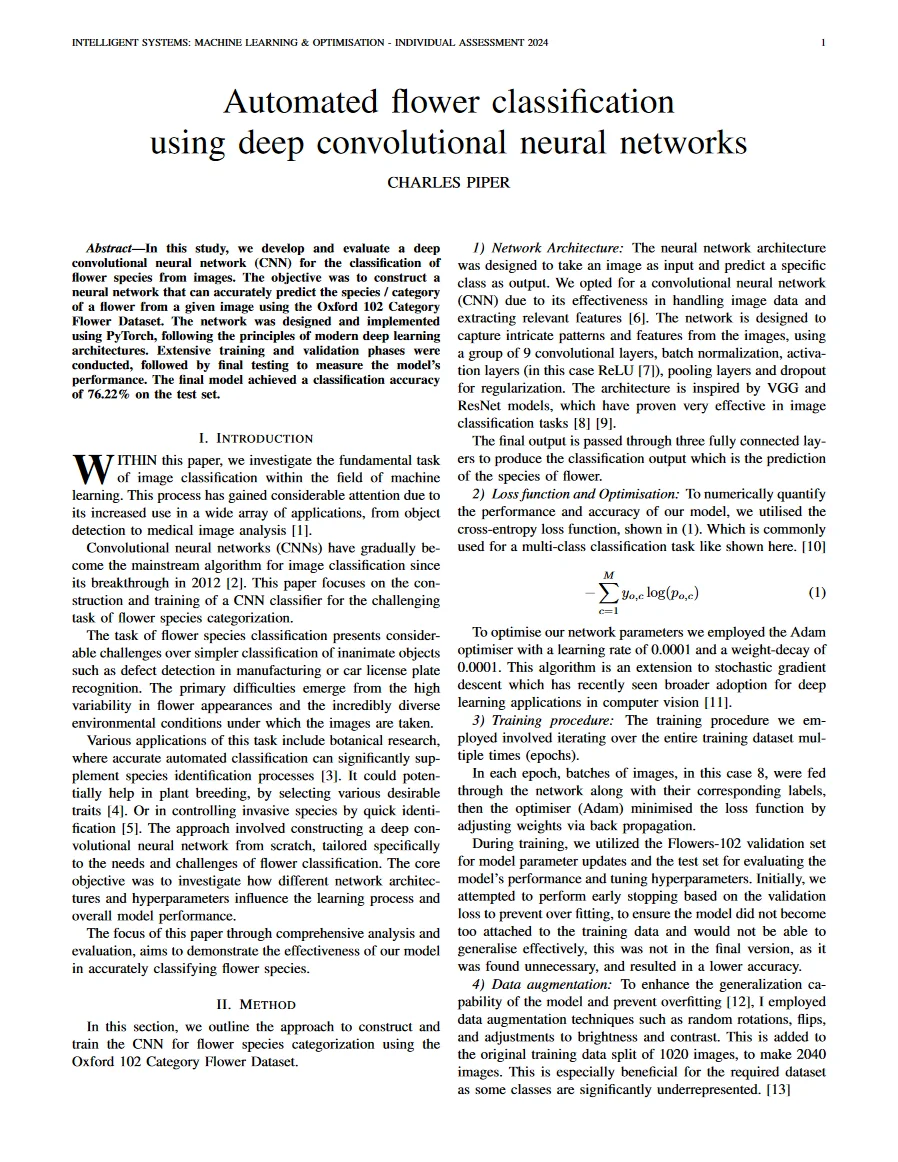 Paper first page
Second page
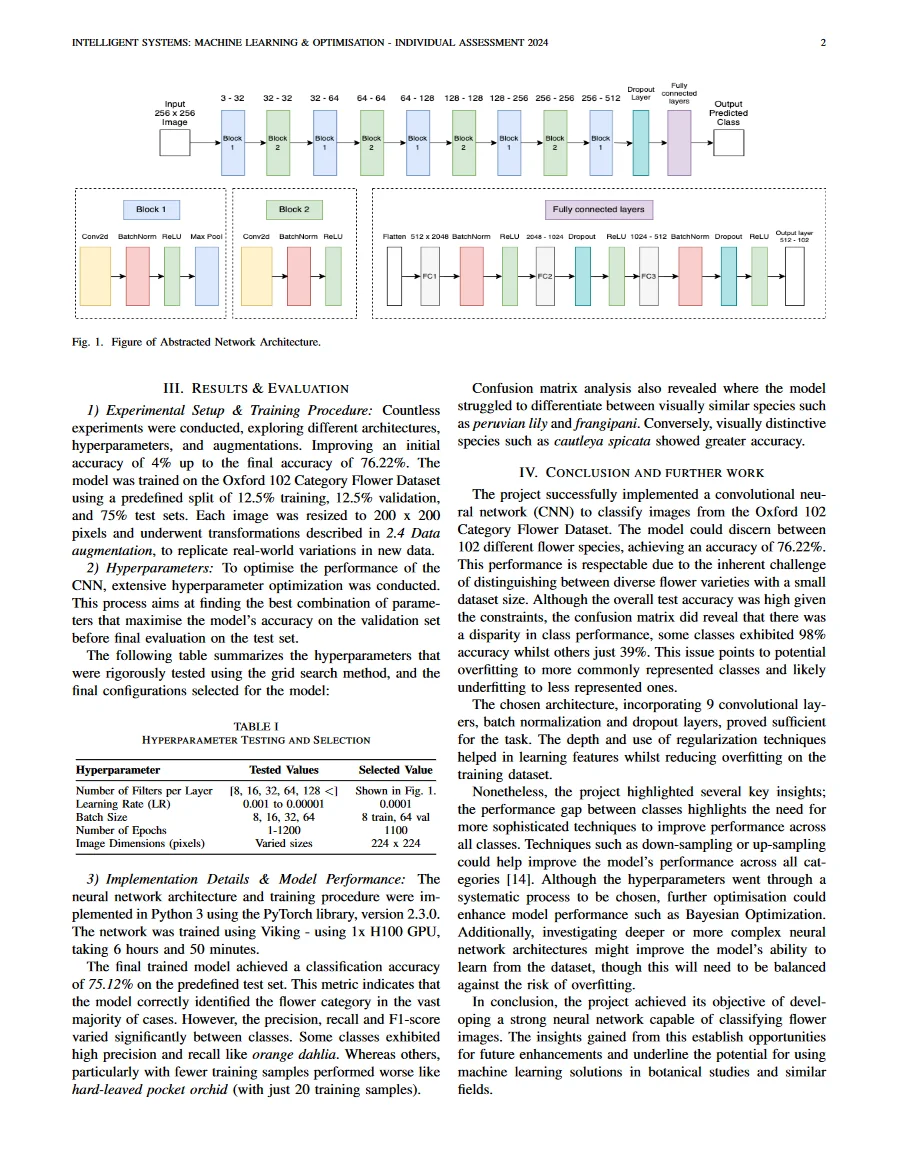 Paper second page